This tutorial shows how to calculate equivalent water thickness or canopy water content (CWC) from BioSCape AVIRIS-NG L3 Reflectance Mosaics data. Variations in CWC can indicate drought stress and wildfire risk.
We will apply a simple fitting of spectral absorption features of liquid water and use scripts available from the ISOFIT package.
Canopy Water Content (CWC)
The CWS is derived from surface reflectance by applying a well-validated algorithm based on a physical model (Beer-Lambert model) (Green et al. 2006; Bohn et al. 2020). Derived surface reflectance spectra were particularly smooth in water absorption bands and include estimates of per-band posterior uncertainties (Thompson et al. 2018). Of note, this model does not account for multiple scattering effects within the canopy and may result in an overestimation of retrieved CWC (Bohn et al. 2020).
References
Bohn, N., L. Guanter, T. Kuester, R. Preusker, and K. Segl. 2020. Coupled retrieval of the three phases of water from spaceborne imaging spectroscopy measurements. Remote Sensing of Environment 242:111708. Bohn et al. (2020)
Green, R.O., T.H. Painter, D.A. Roberts, and J. Dozier. 2006. Measuring the expressed abundance of the three phases of water with an imaging spectrometer over melting snow. Water Resources Research 42:W10402. Green et al. (2006)
Thompson, D.R., V. Natraj, R.O. Green, M.C. Helmlinger, B.-C. Gao, and M.L. Eastwood. 2018. Optimal estimation for imaging spectrometer atmospheric correction. Remote Sensing of Environment 216:355–373. Thompson et al. (2018)
Datasets
Brodrick, P. G., Chlus, A. M., Eckert, R., Chapman, J. W., Eastwood, M., Geier, S., Helmlinger, M., Lundeen, S. R., Olson-Duvall, W., Pavlick, R., Rios, L. M., Thompson, D. R., & Green, R. O. (2025). BioSCape: AVIRIS-NG L3 Resampled Reflectance Mosaics, V2. ORNL Distributed Active Archive Center. Brodrick et al. (2025)
Import modules
Let’s first import the required Python modules.
import numpy as np
import pandas as pd
import matplotlib.pyplot as plt
from scipy.optimize import least_squares
import earthaccess
import xarray as xr
import hvplot.xarray
import holoviews as hv
import warnings
warnings.filterwarnings('ignore')Earthdata Authentication
# ask for EDL credentials and persist them in a .netrc file
auth = earthaccess.login()
Retrieve AVIRIS-NG Spectra
AVIRIS-NG File
We will use the file AVIRIS-NG_BIOSCAPE_V02_L3_33_55 for this tutorial. Let’s retrieve it using the earthaccess python module.
# search granules
granules = earthaccess.search_data(
    doi='10.3334/ORNLDAAC/2427', # Bioscape AVIRIS-NG L2
    granule_name = "*AVIRIS-NG_BIOSCAPE_V02_L3_33_55*", # *ang20231110t070302_007*
)
Let’s print the first granule.
granules[0]We will use earthaccess to retrieve a list of file-like objects on AWS S3 buckets.
# earthaccess open
fh = earthaccess.open(granules)
fh[<File-like object S3FileSystem, ornl-cumulus-prod-protected/bioscape/BioSCape_ANG_V02_L3_RFL_Mosaic/data/AVIRIS-NG_BIOSCAPE_V02_L3_33_55_QL.tif>,
<File-like object S3FileSystem, ornl-cumulus-prod-protected/bioscape/BioSCape_ANG_V02_L3_RFL_Mosaic/data/AVIRIS-NG_BIOSCAPE_V02_L3_33_55_UNC.nc>,
<File-like object S3FileSystem, ornl-cumulus-prod-protected/bioscape/BioSCape_ANG_V02_L3_RFL_Mosaic/data/AVIRIS-NG_BIOSCAPE_V02_L3_33_55_RFL.nc>]Let’s open the reflectance file as xarray datatree.
for f in fh:
    if f.path.endswith("_RFL.nc"):
        # plot a single file netcdf
        ds = xr.open_datatree(f, engine='h5netcdf', chunks={})
#print
dsWe will now convert the reflectance to xarray dataset.
rfl_netcdf = ds.reflectance.to_dataset()
rfl_netcdfWe will plot the reflectance using hvplot.
h = rfl_netcdf.reflectance.sel({'wavelength': 660},method='nearest').hvplot('easting', 'northing',
                                                      rasterize=True, data_aspect=1,
                                                      cmap='magma',frame_width=400,clim=(0,0.03))
hLet’s retrieve a spectra from the AVIRIS-NG file and plot.
rfl_meas = rfl_netcdf.reflectance.isel(northing=1500, easting=1500).values
wl = rfl_netcdf.wavelength.values
plt.axvline(x = 850, color = 'r', alpha=0.6)
plt.axvline(x = 1100, color = 'r', alpha=0.6)
plt.scatter(wl, rfl_meas, alpha=0.6)
plt.xlabel("wavelength")
plt.ylabel("reflectance")
plt.show()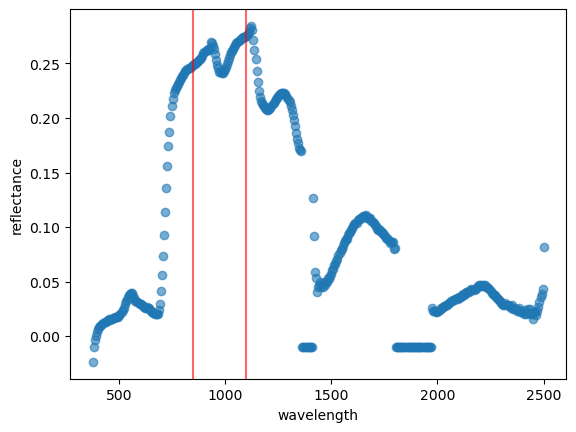
Beer-lambert Law
Let’s define a function that returns the vector of residuals between measured and modeled surface reflectance. The surface reflectance optimizes for the path length of surface liquid water based on the Beer-Lambert attenuation law.
def beer_lambert_model(x, y, wl, alpha_lw):
    """
    Args:
        x:        state vector (liquid water path length, intercept, slope)
        y:        measurement (surface reflectance spectrum)
        wl:       instrument wavelengths
        alpha_lw: wavelength dependent absorption coefficients of liquid water

    Returns:
        resid: residual between modeled and measured surface reflectance
    """

    attenuation = np.exp(-x[0] * 1e7 * alpha_lw)
    rho = (x[1] + x[2] * wl) * attenuation
    resid = rho - y

    return resid
Refractive indices of different water phases
There is a file in the data folder called k_liquid_water_ice.csv, which provides refractive indices of different water phases. This is the imaginary part of the liquid water refractive index. Let’s open that file and display the first few lines.
k_wi = pd.read_csv("data/k_liquid_water_ice.csv")
k_wi.head()The table above provides the imaginary part of the liquid water refractive index for seven temperatures. Let’s plot these values.
fig, axs = plt.subplots(2,4, figsize=(15, 6),  sharex=True, sharey=True, constrained_layout=True)
axs = axs.ravel()
col_n = 0
for i in range(0, 7):
    x = k_wi.iloc[:, col_n+i]
    y = k_wi.iloc[:, col_n+i+1]
    axs[i].scatter(x, y)
    axs[i].set_title(y.name)
    col_n+=1
fig.supylabel('imaginary parts of refractive index')
fig.supxlabel('wavelength')
plt.show()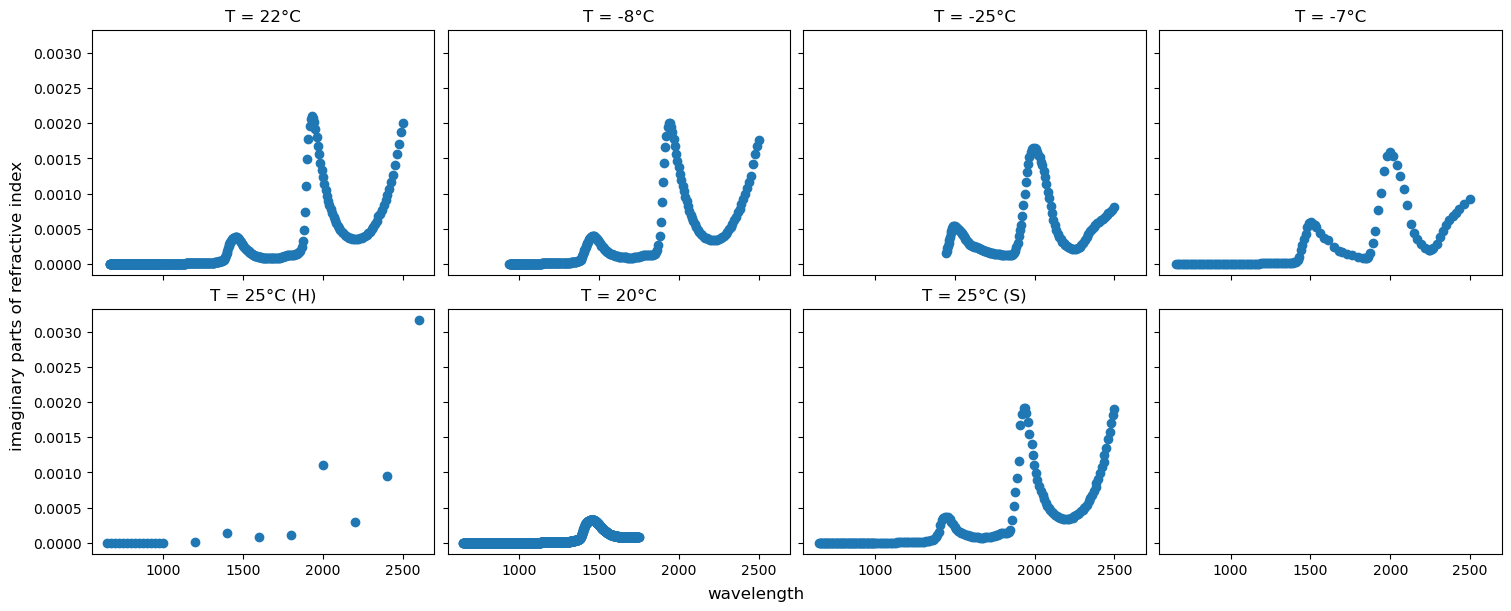
We will use wvl_6 as the wavelength column and T = 20°C as the k column or imaginary parts of refractive index, when doing the inversion below.
Inversion
Given a reflectance estimate, we will fit a state vector including liquid water path length based on a simple Beer-Lambert surface model defined above.
Let’s first define some parameters and bounds.
def invert_liquid_water(wvl):
    """
    Args:
        wvl: wavelengths

    Returns:
        x_opt: least square solution
    """
    # wavelength of left  feature shoulder
    l_shoulder = 850.
    # wavelength of right absorption feature shoulder
    r_shoulder = 1100.
    # initial estimate for liquid water path length, intercept, and slope
    lw_init = (0.02, 0.3, 0.0002)
    # lower and upper bounds for liquid water path length, intercept, and slope
    lw_bounds  = ([0, 0.5], [0, 1.0], [-0.0004, 0.0004])

    # wavelengths
    wl_water = k_wi['wvl_6'].to_numpy()
    # imaginary parts of refractive index
    k_water = k_wi['T = 20°C'].to_numpy()

    # params needed for liquid water fitting
    lw_feature_left = np.argmin(abs(l_shoulder - wvl))
    lw_feature_right = np.argmin(abs(r_shoulder - wvl))
    wl_sel = wvl[lw_feature_left : lw_feature_right + 1]

    kw = np.interp(x=wl_sel, xp=wl_water, fp=k_water)
    abs_co_w = 4 * np.pi * kw / wl_sel

    rfl_meas_sel = rfl_meas[lw_feature_left : lw_feature_right + 1]

    return least_squares(fun=beer_lambert_model, x0=lw_init, jac="2-point", method="trf",
            bounds=(
                np.array([lw_bounds[x][0] for x in range(3)]),
                np.array([lw_bounds[x][1] for x in range(3)]),
            ), max_nfev=15,
            args=(rfl_meas_sel, wl_sel, abs_co_w),
        )

x_opt = invert_liquid_water(rfl_meas)
x_opt
message: `gtol` termination condition is satisfied.
success: True
status: 1
fun: [-2.842e-12]
x: [ 1.789e-02 3.297e-01 2.024e-04]
cost: 4.0380212571120976e-24
jac: [[-2.350e+00 8.626e-01 2.453e-01]]
grad: [ 6.678e-12 -2.451e-12 -6.972e-13]
optimality: 1.6431014911470569e-12
active_mask: [0 0 0]
nfev: 4
njev: 4In the above solution from least square optimization x_opt.x provides the estimated liquid water path length, intercept, and slope, respectively based on a given surface reflectance. Let’s print the Equivalent Water Thickness (EWT) value for the pixel.
print(f"EWT in cm: {x_opt.x[0]:.5f}")EWT in cm: 0.01789
We can use the above function invert_liquid_water and apply to the every pixels of the file, which would be computationally intensive and we won’t be doing in this tutorial.
- Bohn, N., Guanter, L., Kuester, T., Preusker, R., & Segl, K. (2020). Coupled retrieval of the three phases of water from spaceborne imaging spectroscopy measurements. Remote Sensing of Environment, 242, 111708. 10.1016/j.rse.2020.111708
- Green, R. O., Painter, T. H., Roberts, D. A., & Dozier, J. (2006). Measuring the expressed abundance of the three phases of water with an imaging spectrometer over melting snow. Water Resources Research, 42(10). 10.1029/2005wr004509
- Thompson, D. R., Natraj, V., Green, R. O., Helmlinger, M. C., Gao, B.-C., & Eastwood, M. L. (2018). Optimal estimation for imaging spectrometer atmospheric correction. Remote Sensing of Environment, 216, 355–373. 10.1016/j.rse.2018.07.003
- Brodrick, P. G., Chlus, A. M., Eckert, R., Chapman, J. W., Eastwood, M., Geier, S., Helmlinger, M., Lundeen, S. R., Olson-Duvall, W., Pavlick, R., Rios, L. M., Thompson, D. R., & Green, R. O. (2025). BioSCape: AVIRIS-NG L3 Resampled Reflectance Mosaics, V2. Oak Ridge National Laboratory, Oak Ridge, Tennessee, USA. 10.3334/ORNLDAAC/2427